


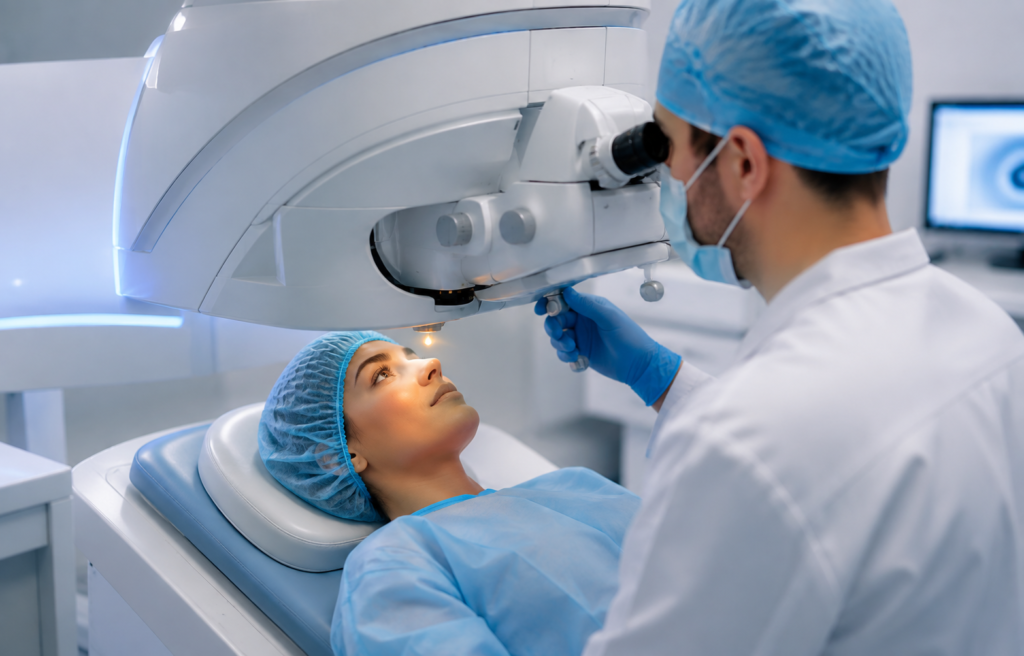

PTK Surgery for Superficial Corneal Conditions
Phototherapeutic Keratectomy uses precise excimer laser technology to treat selected corneal surface disorders, scars and irregularities.
Book Appointment
Get your Booking to get emergency service
What is PTK Surgery?
Phototherapeutic Keratectomy (PTK) is a therapeutic laser procedure that uses an excimer laser to treat abnormalities affecting the superficial layers of the cornea.
Unlike PRK, which is primarily performed to correct refractive errors, PTK is used to address selected corneal surface problems such as superficial scars, opacities, dystrophies and irregularities. By removing the affected superficial tissue in a controlled manner, PTK may help improve the smoothness and clarity of the corneal surface.
A comprehensive corneal evaluation is essential before treatment to determine whether PTK is appropriate and how deeply the affected tissue can be treated.
Why Choose PTK?

Precise Excimer Laser
Controlled laser treatment targets selected superficial corneal tissue.

Surface-Level Treatment
PTK is designed to address abnormalities affecting the anterior corneal surface.

Controlled Tissue Removal
Treatment depth can be planned according to the location and characteristics of the corneal condition.

Therapeutic Approach
PTK focuses on treating selected corneal surface disorders rather than simply correcting spectacle power.

Personalised Treatment
Each treatment plan is based on detailed corneal examination and individual eye health.

Minimally Invasive Laser Procedure
PTK uses excimer laser technology to treat appropriate superficial corneal abnormalities without conventional surgical excision.

Every patient undergoes a comprehensive eye examination
to determine whether SMILE is the most appropriate treatment option.
How PTK Surgery Works
Corneal Evaluation
The cornea is examined to identify the location, extent and depth of the abnormality.
Treatment Planning
The ophthalmologist determines the appropriate laser treatment based on the corneal findings.
Surface Preparation
The affected corneal surface is prepared for the planned laser treatment.
Excimer Laser Treatment
The laser precisely removes selected superficial corneal tissue.
Corneal Healing
The treated surface heals gradually under appropriate post-operative care.
Recovery After PTK Surgery
- Mild discomfort, watering or light sensitivity may occur during the initial healing period.
- A bandage contact lens may be placed to support epithelial healing when advised.
- Prescribed eye drops should be used exactly as directed.
- Avoid rubbing the treated eye during recovery.
- Follow-up examinations help monitor epithelial healing and corneal recovery.
Is PTK Right for You?
PTK may be considered for patients with selected superficial corneal conditions, including certain corneal scars, opacities, dystrophies and surface irregularities. It may also be considered in selected cases of recurrent corneal erosion when other treatment approaches have not provided sufficient relief.
A detailed corneal examination is necessary before PTK. Your ophthalmologist will assess the location and depth of the corneal abnormality, corneal thickness, visual needs and overall eye health to determine whether PTK is an appropriate treatment option.
Benefits of PTK Surgery
- Precise Excimer Laser Treatment.
- Treatment of Selected Corneal Surface Disorders.
- Controlled Superficial Tissue Removal.
- Smoother Corneal Surface.
- Minimally Invasive Laser Procedure.
- Personalised Treatment Planning.
- May Improve Corneal Clarity.
- May Reduce Surface-Related Discomfort.
AAdvanced Technology for Corneal Treatment
At Dr. P. S. Hardia Eye Hospital, detailed corneal assessment plays an important role in PTK treatment planning. Advanced diagnostic imaging can help evaluate the corneal surface and the depth of an abnormality before laser treatment.
Precise laser ablation for selected superficial corneal abnormalities.
Detailed assessment of corneal structure and surface characteristics.
Treatment parameters are planned according to the patient's specific corneal condition.