


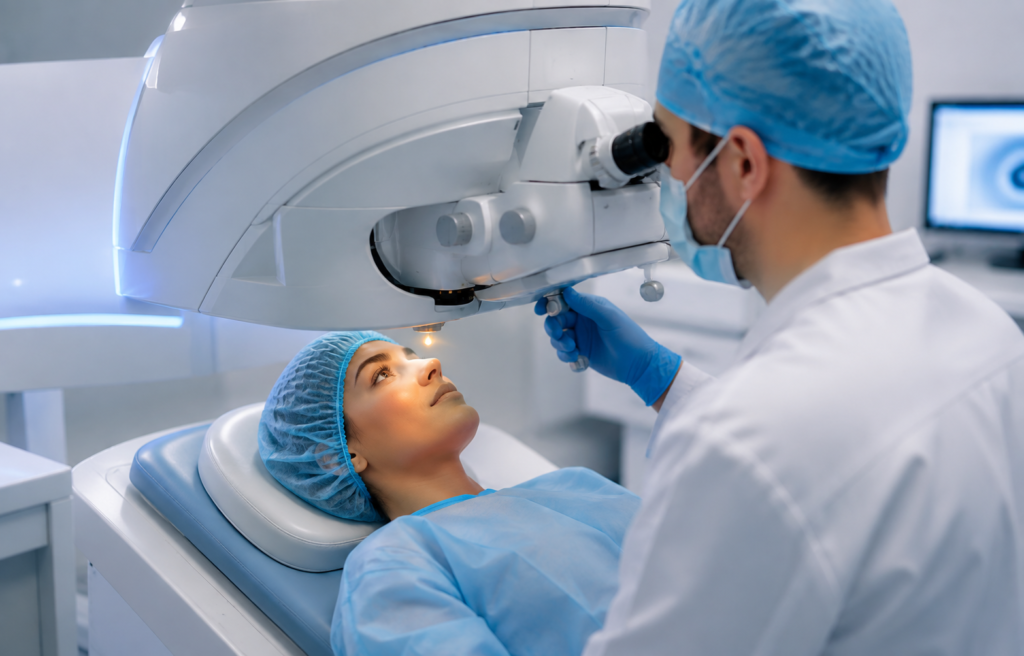

PTK Surgery for Superficial Corneal Conditions

Phototherapeutic Keratectomy uses precise excimer laser technology to treat selected corneal surface disorders, scars and irregularities.

Book Appointment

Get your Booking to get emergency service


    What is PTK Surgery?

    Phototherapeutic Keratectomy (PTK) is a therapeutic laser procedure that uses an excimer laser to treat abnormalities affecting the superficial layers of the cornea.

    Unlike PRK, which is primarily performed to correct refractive errors, PTK is used to address selected corneal surface problems such as superficial scars, opacities, dystrophies and irregularities. By removing the affected superficial tissue in a controlled manner, PTK may help improve the smoothness and clarity of the corneal surface.

    A comprehensive corneal evaluation is essential before treatment to determine whether PTK is appropriate and how deeply the affected tissue can be treated.

    Why Choose PTK?

    Precise Excimer Laser

    Controlled laser treatment targets selected superficial corneal tissue.

    Surface-Level Treatment

    PTK is designed to address abnormalities affecting the anterior corneal surface.

    Controlled Tissue Removal

    Treatment depth can be planned according to the location and characteristics of the corneal condition.

    Therapeutic Approach

    PTK focuses on treating selected corneal surface disorders rather than simply correcting spectacle power.

    Personalised Treatment

    Each treatment plan is based on detailed corneal examination and individual eye health.

    Minimally Invasive Laser Procedure

    PTK uses excimer laser technology to treat appropriate superficial corneal abnormalities without conventional surgical excision.


    Every patient undergoes a comprehensive eye examination

    to determine whether SMILE is the most appropriate treatment option.

    How PTK Surgery Works

    1

    Corneal Evaluation

    The cornea is examined to identify the location, extent and depth of the abnormality.

    2

    Treatment Planning

    The ophthalmologist determines the appropriate laser treatment based on the corneal findings.

    3

    Surface Preparation

    The affected corneal surface is prepared for the planned laser treatment.

    4

    Excimer Laser Treatment

    The laser precisely removes selected superficial corneal tissue.

    5

    Corneal Healing

    The treated surface heals gradually under appropriate post-operative care.

    Recovery After PTK Surgery

    Is PTK Right for You?

    PTK may be considered for patients with selected superficial corneal conditions, including certain corneal scars, opacities, dystrophies and surface irregularities. It may also be considered in selected cases of recurrent corneal erosion when other treatment approaches have not provided sufficient relief.

    A detailed corneal examination is necessary before PTK. Your ophthalmologist will assess the location and depth of the corneal abnormality, corneal thickness, visual needs and overall eye health to determine whether PTK is an appropriate treatment option.

    Benefits of PTK Surgery

    AAdvanced Technology for Corneal Treatment

    At Dr. P. S. Hardia Eye Hospital, detailed corneal assessment plays an important role in PTK treatment planning. Advanced diagnostic imaging can help evaluate the corneal surface and the depth of an abnormality before laser treatment.

    Excimer Laser Technology

    Precise laser ablation for selected superficial corneal abnormalities.

    Corneal Imaging

    Detailed assessment of corneal structure and surface characteristics.

    CIndividualised Treatment Planning

    Treatment parameters are planned according to the patient's specific corneal condition.

    Our approach focuses on careful diagnosis, appropriate patient selection and personalised corneal care.
    FREQUENTLY ASKED QUESTIONS

    Frequently Asked Questions

    1. What is PTK surgery?
    PTK stands for Phototherapeutic Keratectomy. It is an excimer laser procedure used to treat selected superficial corneal disorders, scars, opacities and irregularities.
    2. Is PTK the same as PRK?
    No. Although both procedures use an excimer laser, their primary purposes are different. PRK is a refractive procedure used for vision correction, while PTK is primarily therapeutic and targets selected superficial corneal abnormalities.
    3. What conditions can PTK treat?
    Depending on the individual case, PTK may be considered for superficial corneal scars, certain corneal dystrophies, recurrent corneal erosions, surface irregularities and other anterior corneal conditions.
    4. Is PTK surgery painful?
    Anaesthetic eye drops are used during the procedure. Some discomfort, watering, light sensitivity or irritation may occur during the early healing period.
    5. How long does recovery take after PTK?
    Recovery depends on the condition being treated and the depth and area of laser treatment. The corneal surface heals gradually, and your ophthalmologist will monitor the healing during follow-up visits.
    6. Can PTK improve vision?
    PTK may improve visual quality when superficial corneal abnormalities are affecting the corneal surface. However, the visual outcome depends on the underlying condition, its depth and the overall health of the eye.

    About Us

    At Dr. P. S. Hardia Advanced Eye Surgery and Research Cente, we are dedicated to delivering exceptional healthcare with compassion, innovation, and integrity. For over 20 years, we have been a offering comprehensive medical services 

    Contact Info

    dr.pshardia@rediffmail.com
    Dr. P. S. Hardia Eye Hospital Bypass Chouraha, A.B. Road, Opp. Papaya Tree Hotel, Rau, Indore, Madhya Pradesh 453331