


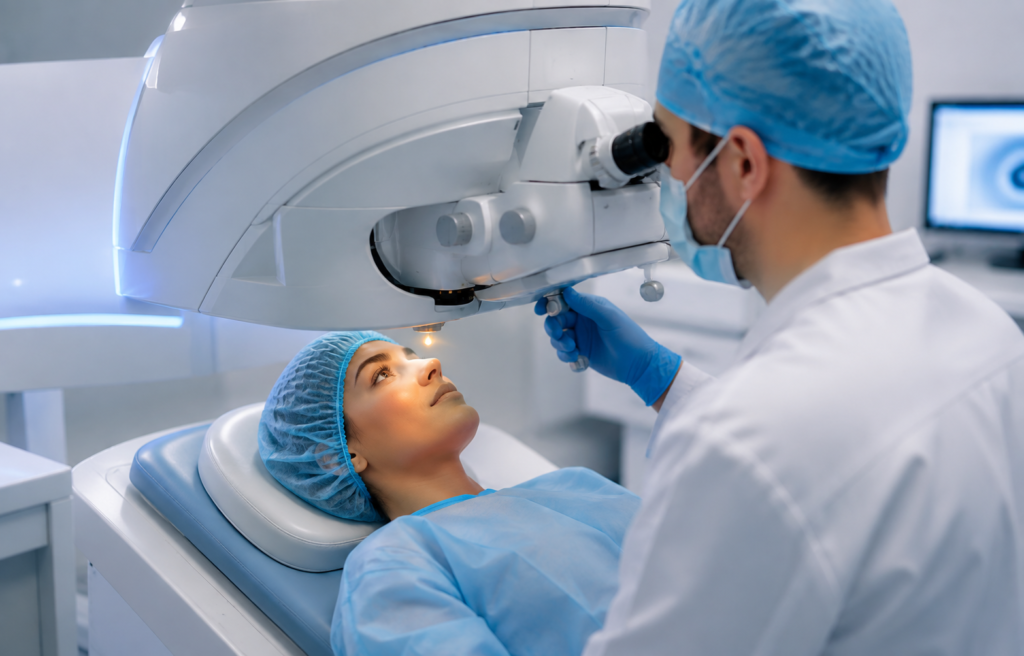

Advanced IOL Options for Cataract Surgery in Indore

Explore modern intraocular lens options including Monofocal, Trifocal, Toric and EDOF lenses, selected according to your eye health, visual needs and lifestyle.

Book Appointment

Get your Booking to get emergency service


    What are Intraocular Lenses (IOLs)?

    An intraocular lens (IOL) is an artificial lens implanted inside the eye during cataract surgery after the cloudy natural lens has been removed. The IOL helps focus light correctly on the retina and plays an important role in restoring clear vision.

    Different IOL designs provide different ranges of vision. Monofocal lenses generally provide clear vision at one primary distance, while Trifocal and EDOF lenses are designed to provide a broader range of useful vision. Toric IOLs are specifically designed to correct corneal astigmatism and can also be available in different optical designs.

    The most suitable IOL depends on your eye health, corneal condition, prescription, lifestyle and visual expectations.

    IOL Options for Cataract Surgery

    Monofocal IOL

    Designed to provide clear vision at one primary distance, most commonly distance vision. Glasses may still be needed for intermediate or near activities.

    Trifocal IOL

    Designed to provide vision across three useful ranges distance, intermediate and near helping reduce dependence on spectacles for selected patients.

    Toric IOL

    Designed to correct regular corneal astigmatism during cataract surgery. Toric IOLs can also be combined with other lens designs for suitable patients.

    EDOF IOL

    Extended Depth of Focus lenses are designed to provide a broader range of vision, particularly extending useful vision from distance towards intermediate ranges.

    Vivity IOL

    Vivity is a specific non-diffractive EDOF lens designed to extend the range of vision while maintaining distance and intermediate visual performance.


    Why Choose the Right IOL?

    Multiple Lens Options

    Different IOL designs provide different ranges and qualities of vision.

    Astigmatism Correction

    Toric IOLs can address suitable cases of corneal astigmatism during cataract surgery.


    Reduced Spectacle Dependence

    Selected premium and advanced IOLs may reduce the need for glasses for certain activities.

    Personalised Vision Goals

    Lens selection is based on your daily activities and visual requirements.

    Every patient undergoes a comprehensive eye examination

    to determine whether SMILE is the most appropriate treatment option.

    What Happens During the Procedure?

    1

    Anaesthetic Eye Drops

    Numbs the eye for comfort

    2

    Laser Creates Lenticule

    Femtosecond laser creates a thin lens

    3

    Tiny Incision

    A small opening is made

    4

    Lenticule Removed

    The lenticule is gently removed

    5

    Clear Vision

    Improved vision without flap

    Monofocal vs Trifocal vs Toric vs EDOF IOLs

    Each IOL design serves a different visual requirement.

    Monofocal IOLs generally provide clear vision at one selected distance. Trifocal IOLs aim to provide useful vision across distance, intermediate and near ranges. Toric IOLs are designed to correct suitable corneal astigmatism and may be available with different optical designs. EDOF IOLs extend the range of useful vision, particularly towards intermediate distances.

    Your ophthalmologist will consider your eye measurements, lifestyle and visual expectations before recommending an IOL.

    How is the Right IOL Selected?

    Is an Advanced IOL Right for You?

    Advanced IOLs may be considered for patients who want to reduce their dependence on glasses after cataract surgery. The appropriate option depends on several factors, including your eye health, corneal condition, astigmatism, lifestyle, visual priorities and expectations.

    A detailed examination is essential before selecting an IOL. Your ophthalmologist will assess your eyes and discuss the potential benefits and limitations of each lens option before recommending the most appropriate choice for your individual needs.

    Benefits of Advanced IOL Options

    AAdvanced Technology for Accurate IOL Selection

    At Dr. P. S. Hardia Eye Hospital, careful pre-operative assessment is an important part of cataract surgery and IOL selection. Accurate measurements help determine the appropriate lens power and identify factors that may influence the choice of IOL.

    Advanced Biometry

    Precise measurements help calculate the required IOL power.

    Corneal Assessment

    Corneal shape and astigmatism are evaluated for appropriate lens selection.

    Personalised IOL Planning

    Lens selection is based on individual eye characteristics and visual requirements.

    Our approach combines detailed diagnostic evaluation with personalised treatment planning to help patients make informed decisions about their cataract surgery and IOL options.
    FREQUENTLY ASKED QUESTIONS

    Frequently Asked Questions

    1. What is an IOL?
    An IOL, or intraocular lens, is an artificial lens implanted inside the eye during cataract surgery after the cloudy natural lens has been removed.
    2. What is a Monofocal IOL?
    A Monofocal IOL is designed to provide clear vision at one primary distance, most commonly distance vision. Glasses may still be required for near or intermediate tasks.
    3. What is a Trifocal IOL?
    A Trifocal IOL is designed to provide useful vision at distance, intermediate and near ranges, potentially reducing spectacle dependence for suitable patients.
    4. What is a Toric IOL?
    A Toric IOL is designed to correct regular corneal astigmatism during cataract surgery. It may be available in different lens designs depending on the patient's requirements.
    5. What is an EDOF IOL?
    EDOF stands for Extended Depth of Focus. These lenses are designed to extend the range of useful vision, particularly between distance and intermediate vision.
    7. Which IOL is best for cataract surgery?
    There is no single IOL that is ideal for every patient. The appropriate lens depends on your eye health, astigmatism, lifestyle, visual requirements and expectations. Your ophthalmologist can recommend the most suitable option after a detailed examination.
    8. Will I still need glasses after IOL surgery?
    The need for glasses depends on the IOL selected and your individual visual requirements. Some advanced IOLs may reduce spectacle dependence, but glasses can still be needed for certain activities.

    About Us

    At Dr. P. S. Hardia Advanced Eye Surgery and Research Cente, we are dedicated to delivering exceptional healthcare with compassion, innovation, and integrity. For over 20 years, we have been a offering comprehensive medical services 

    Contact Info

    dr.pshardia@rediffmail.com
    Dr. P. S. Hardia Eye Hospital Bypass Chouraha, A.B. Road, Opp. Papaya Tree Hotel, Rau, Indore, Madhya Pradesh 453331